Decoding the Hoof Capsule
8 Hoof Types Explained
©2011, EQUUS-the balanced equation
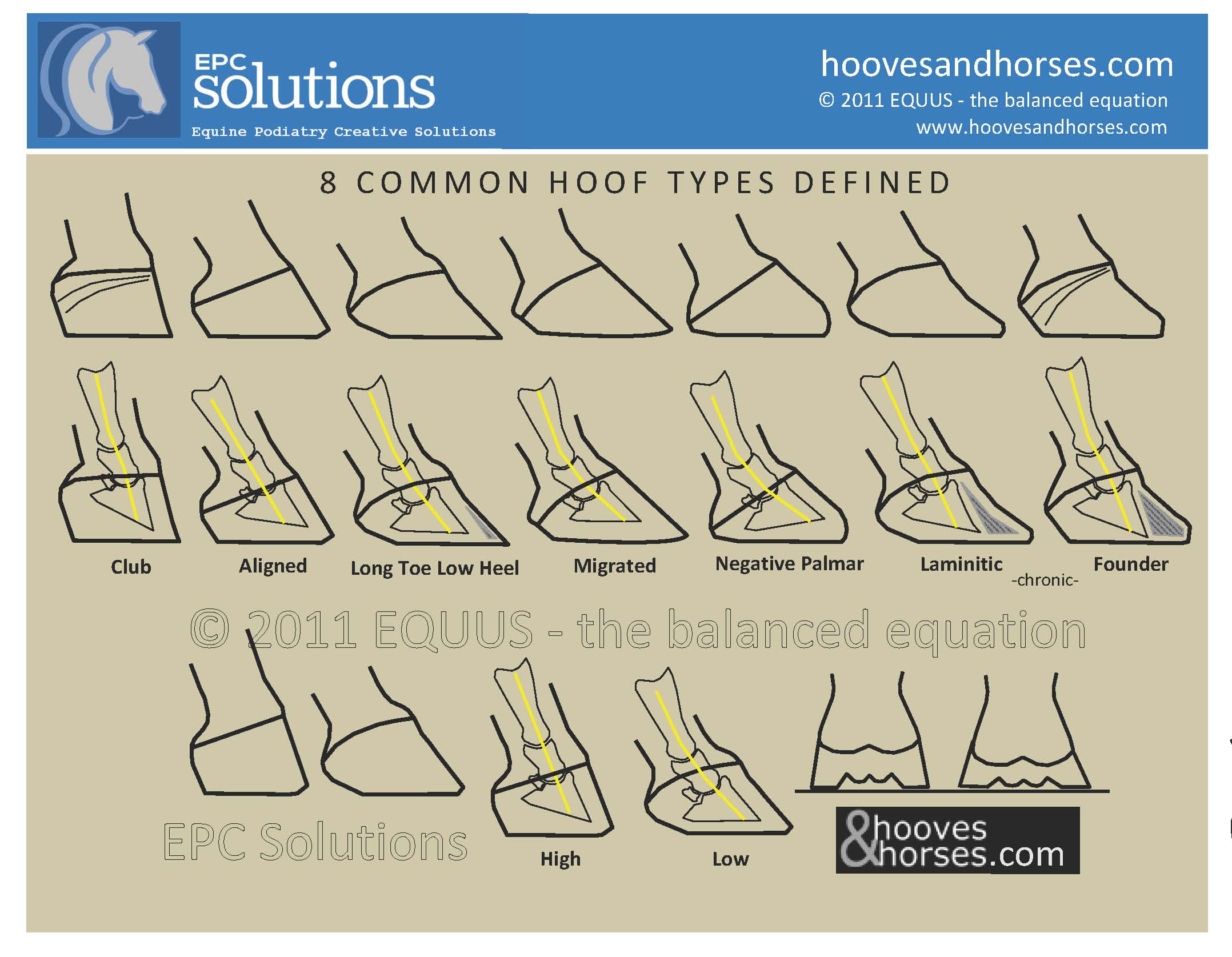
Note these models were created for illustration purposes only, and may not be anatomically correct- rather the purpose is to show various bony column alignments that predispose hooves to pathological changes to aid in developing a corrective trim process.
 |
The Healthy Hoof • the bony column is aligned • there is laminae integrity • dorso palmar and medio-lateral balance supports the bony column under the limb with optimal breakover • extensor process is high in the hoof capsule sling with good sole concavity and uniform sole thickness • good form of structures: bars are straight, good heel base, healthy frog tissue and fibrous digital cushion and collateral cartilages • tight suspensory system and healthy joint function So What is "Normal"? Presentation of an appealing hoof that is considered to be functionally sound. It may be difficult to verbally define “normal”. |
Defining "Normal"
There is no one formula that works for every horse in every situation. For each horse, we can often envision it without being able to actually describe it. “Normal” varies from horse to horse and is essentially a hoof that works for that horse, considering his work and environment which varies with time and circumstance. Normal aka healthy hoof.
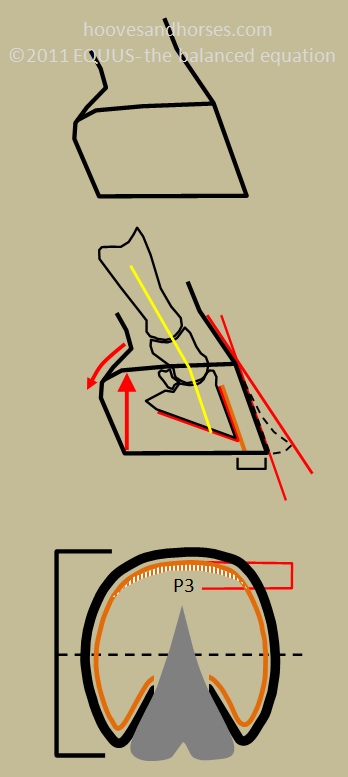 |
Upright Conformation The Upright Pathological Hoof: • Club Foot • DDFT Contracture • Up/Down Conformation • High/Low Heel Syndrome • High Heel/wider growth rings at heel • “Boxy” Hoof The pathological hoof presents with a Broken Forward Bony Column at P2/P3 and upright P1-Pastern pushed forward The classic example is the “club foot” but this is only one of many variations on this theme. Increased tension of the deep digital flexor tendon appears to be the primary cause. This condition can be congenital or acquired. |
There are four grades of club foot
Grades 1 to 4 as follows:
Grade 1 – Only note a difference in the hoof angles that returns with each trim
Grade 2 – Greater difference in hoof angles, growth rings begin to change. There is an air gap (space between the bottom of the heel and the ground bearing surface- heel does not fully weight bear/load on the ground
Grade 3 – Front wall is dished (laminitic) and growth rings at the heel are twice as wide as the anterior (front, dorsal) wall. Tip of P3 is starting to demineralization
Grade 4 – front hoof wall presents with 80+ degree hoof angle and severe dish. Severe P3 changes, sole extends below wall
The Upright Non-Pathological Hoof
An upright distal limb conformation may have a more upright hoof capsule, but it presents with an aligned bony column and is in line with a normal configuration for upright conformation.
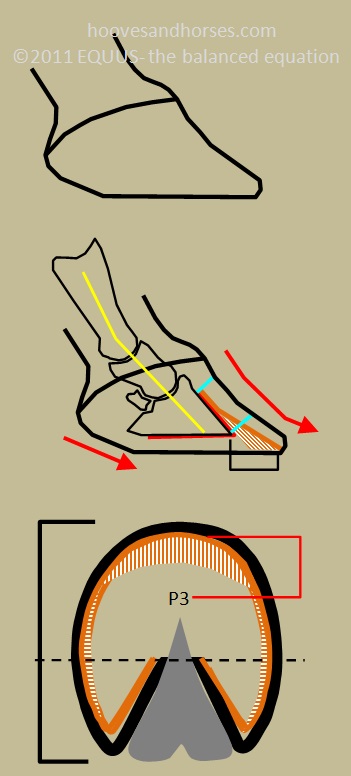 |
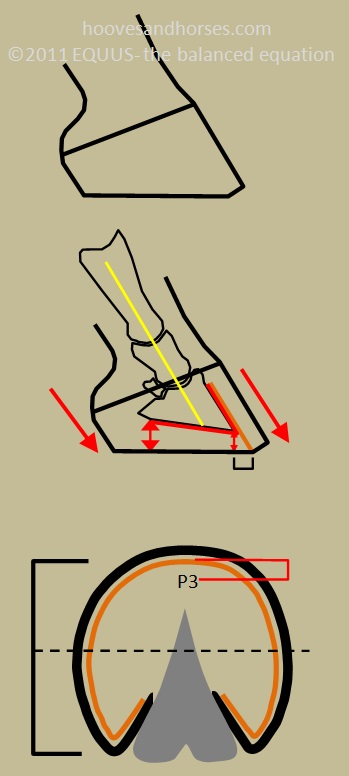
Elongated Toe/ Low or Underrun Heel Also known as LTUH: Long Toe, Underun Heel Common characteristics: • Typical Long dished/flared toe
|
This hoof capsule configuration causes many difficulties for farriers and veterinarians alike. It is involved in many lameness issues, and can be difficult to correct if the trimming protocol is not adapted to address the hoof distortion.
In the past, various hoof distortions were generalized and lumped into one hoof type called LTUH or LTLH. We propose to look at these hoof distortions and further categorize the long toed hoof capsules into three distinct groupings:
1. LTUH, LTLH
2. Migrated Hoof Capsule
3. BullNosed Hoof Capsule/Negative Palmar Angle
If you would like to learn more about these additional hoof types, how to identify, correct and restore hoof biomechanics, please contact us for a consult or ask about enrolling in one of our podiatry education courses. We'd love to empower you with knowledge, skills and toolsets to make a positive difference with the horses under your care!


* Patented Advanced Technology *
Delivers pre/probiotics intact
to the hind gut